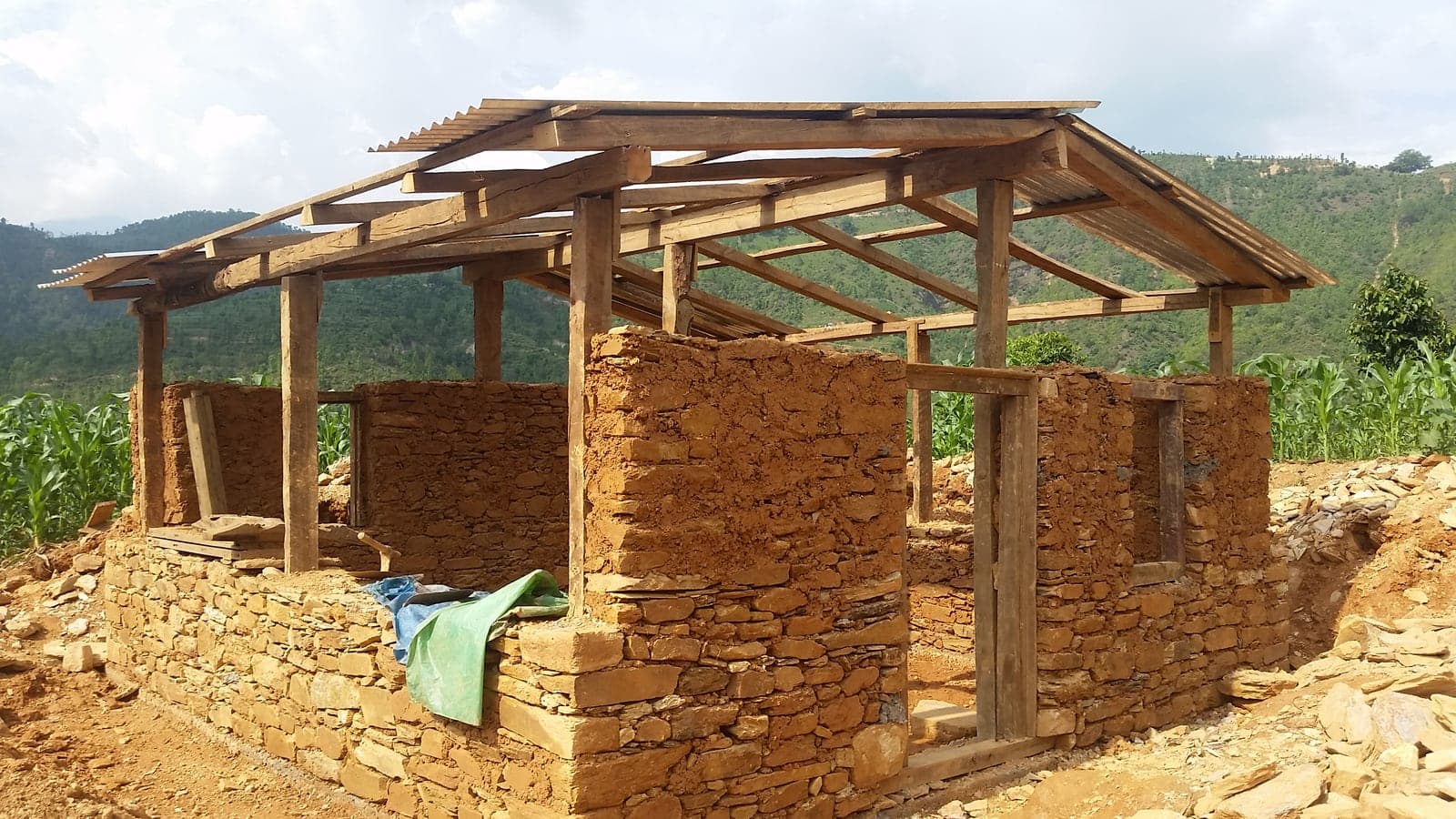
A transition home nearing roof completion at Sipapokhare, 29 June 2015.2015-06-29 · Mission Rebuild Nepal
Summary
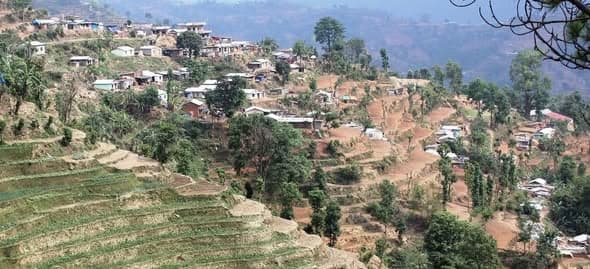
Sipapokhare is a village development committee in southern Sindhupalchowk, about 40 miles north-east of Kathmandu. The 2015 earthquakes destroyed or critically damaged almost all of its 998 homes and killed around 100 of its 3,700 residents. Mission Rebuild Nepal set out to give every displaced household a transition home: a timber frame on a stone plinth, walls of local stone and mud, and a corrugated zinc roof, built by the families who would live in it. When the project closed in June 2017, a ward-by-ward physical count confirmed 800 houses delivered.
Worked with
Team Karma
Sindhu Utthan Kendra
Nepal Education and Cultural Center (NECC)
America Nepal Medical Foundation (ANMF)
America Nepal Helping Society (ANHS)
Himalayan White House College
Figures
What this project recorded
Each figure is drawn from the organisation's own records. The documents behind them are released on request.
800
Transition homes delivered
Confirmed by a physical count of every house across all nine wards of the VDC.
998
Homes destroyed or critically damaged
Effectively the entire housing stock of the VDC.
4,000+
Individuals housed
Including single women, children, elderly people and members of marginalised communities.
US$450
Cost of one home
After the September 2015 design revision. The original per-unit estimate was US$335.
9
Wards counted
Every ward of the VDC was walked and its houses counted before the project was declared complete.
Sipapokhare sits in the mountains about 40 miles north-east of Kathmandu, in the southern part of Sindhupalchowk. Of its roughly 998 homes, almost none survived April and May 2015 intact. Around 100 of the VDC's 3,700 residents were killed and another hundred injured. Every surviving household was living under tarpaulin or salvaged material, and the monsoon was weeks away.
Most families in the VDC farm for a living, and the land produces enough to feed them for about six months of the year. The rest is earned through labouring in nearby towns. Tamang, Damai, Kami and Sarki households, among the most marginalised communities in Nepal, make up much of the village alongside Brahmin and Chhetri families. In the makeshift shelters that went up after the earthquake, up to thirty people from five families were seen sharing twelve feet by twelve.
Sipapokhare was chosen at a meeting of volunteers and local leaders in Kathmandu on 2 May 2015. Around 600 VDCs across fifteen districts had suffered comparable damage. Sipapokhare was picked because local activists could be organised quickly, because around half the villagers came from indigenous communities, and because a cluster of houses hosting a wedding had collapsed there, killing more than five dozen residents and guests.
Frame and plinth going up on a cleared site, 25 June 2015. The stone comes from the house that stood there before.2015-06-25 · Mission Rebuild Nepal
The shelter
The first concept, drawn up with Team Karma in the weeks after the earthquake, was a bamboo structure with walls reinforced by clay and cow dung and a corrugated zinc roof, costed at around US$170 to US$200 a unit. What was actually built was heavier and more durable. A timber frame carries the roof; the walls are laid up from stone recovered from the collapsed house and bedded in mud; the plinth is stone with a cement course; the roof is corrugated galvanised iron. Tie bands run at sill level and above the window and door line. Lintels were absent from the model house and were added in the revised design: wooden logs rather than iron beams, since the roof load is light.
The itemised budget in the July 2015 proposal comes to NPR 43,497.50 a shelter, about US$435 at the exchange rate of the time: sand, aggregate, seven bags of cement, 30 kg of reinforcement bar, 2.25 bundles of CGI sheet, hold-fasts for the frame and posts, binding wire, enamel, nails, four man-days of skilled labour, transport, and a share of operating cost. In September 2015 the engineers submitted a modified design and MRN added a procurement manager and a site engineer to oversee quality. The per-unit cost settled at about US$450, and that is the figure the organisation used in its appeals from then on.
The revised design, published for comment on 24 September 2015.2015-09-24 · Mission Rebuild Nepal
Built by the households who would live in them
MRN and Team Karma supplied the materials, the tools, the safety equipment, the technical supervision and the training. The residents supplied the labour and built their own houses. Team Karma is a group of US-based doctors and an architect, all of whom grew up in Nepal; MRN and Team Karma took decisions on the project jointly. On the ground the local partner was Sindhu Utthan Kendra, an NGO that had worked in the VDC for years and provided office space, storage, community outreach and access to local resources. Engineering and business administration students, many of them from Himalayan White House College, volunteered on the ground team, and a steering committee of villagers was formed to organise local materials and labour.
Households with elderly members, infants, toddlers or expectant mothers were given priority. Residents led the identification of building sites, since where a house goes is a contentious matter in a village, and the ground team facilitated rather than directed. Sites were only accepted where the ground was judged geologically stable, which after an earthquake and before a monsoon was not a formality.
“During that time, the residents of Sipapokhare welcomed me into their lives, not just to work side by side with them in rebuilding their homes, but to immerse myself in their community. Though I joined MRN as a volunteer to lend a hand to the villagers, I left having received far more from them.”
Fixing roofing sheet, 8 June 2015. Procurement of zinc sheet was the project's tightest constraint in the first months.2015-06-08 · Mission Rebuild Nepal
Two long interruptions
The first was the monsoon. By 19 August 2015, 71 of the 76 houses at Adchale tole were finished and work stopped: bad weather, and roads that could not carry material. The second was worse. From late September 2015 a fuel crisis and the closure of the Indian border cut off cement and other raw materials. On 15 November MRN told its donors that 100 houses were under construction, that they could not be completed even in two months for want of cement, and that the project would be suspended indefinitely. Eight days later the organisation had bought enough cement for those 100 houses from multiple sources at above-normal prices, and construction resumed.
What was actually built
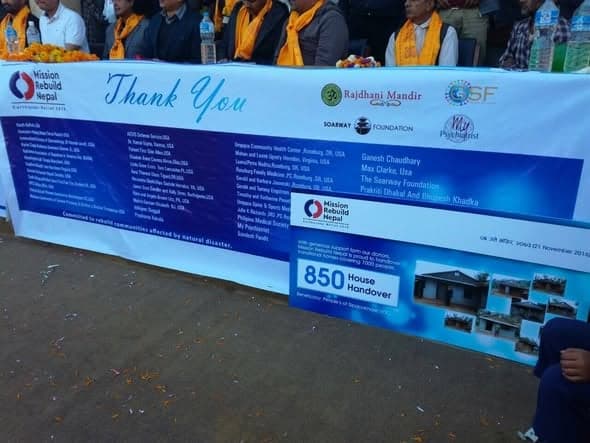
Five model homes were finished by 19 May 2015 and the first seven houses by 1 July. Fifty-eight were complete by the end of July, and the first handover ceremony was held at Sipapokhare on 12 September 2015 with Dr Bhagawan Koirala as chief guest. By mid-February 2016, 265 houses were complete and 175 handed over. A second handover took place on 12 March 2016 on the grounds of Rajeshwori School in front of about 1,500 villagers, bringing the total delivered to 368. Around 450 were standing by the end of May 2016 and around 500 by mid-June, with 250 more under construction. The final handover ceremony was held on 21 November 2016.
2015-05-02
Sipapokhare VDC selected at a meeting of volunteers and local leaders in Kathmandu.
2015-05-19
Five model homes completed. Materials bought for an immediate 200.
2015-06-27
Memorandum issued to government officials and stakeholders: MRN owns and manages the project, Sindhu Utthan Kendra is its local partner.
2015-07-01
Seven houses complete, materials on site for 45 more. About US$62,000 raised for relief and rebuilding combined.
2015-08-19
71 of 76 houses complete at Adchale tole. Work halted by weather and road conditions.
2015-09-12
First handover ceremony at Sipapokhare, with Dr Bhagawan Koirala as chief guest.
2015-09-24
Revised design published. Per-unit cost rises to about US$450.
2015-11-15
Project suspended indefinitely. Cement unobtainable during the border blockade.
2015-11-23
Cement secured at above-normal prices for 100 houses. Construction resumes.
2016-03-12
Second handover ceremony at Rajeshwori School before about 1,500 villagers. 368 houses delivered to date.
2016-11-21
Final handover ceremony.
2017-06-14
Ward-by-ward verification complete. 800 houses confirmed delivered and the project closed.
A completed house, February 2016. The plaque above the door records the donor and the household.2016-02-29 · Mission Rebuild Nepal
Questions donors asked
Tie bands and lintels
Tie bands run at sill level and along the top of the walls at window height. Above the door and window line there is a ply board, and between that board and the wall a long wooden beam acts as a lintel. Lintels are conventionally iron beams, but the roof load on these houses is light enough for wooden logs to carry it. The model house was built without lintels; the revised design includes them.
Team Karma
A team of medical doctors and an architect based in the United States, all of whom grew up in Nepal. Team Karma worked with earthquake survivors from immediately after 25 April 2015 and then partnered with MRN on the Sipapokhare transition homes. The two organisations took crucial decisions on the project jointly.
Sindhu Utthan Kendra
The local NGO that acted as MRN's partner in the VDC, supporting logistics, community outreach and local management, and providing office space, storage and access to local resources. All of the funds applied to the project came from MRN. A memorandum issued on 27 June 2015 stated plainly that MRN owned the project and Sindhu Utthan Kendra was its local partner, not its owner.
How money reached Nepal
Donations were deposited in MRN's US bank account and transferred as needed to its sister organisation's account in Nepal, where withdrawals required three signatures. Each wire cost US$30, counted as an administrative expense.
How spending was controlled
The country director and the Nepal board submitted a monthly estimate. Forty per cent of it was transferred in the first round. When roughly 50 to 80 per cent of that had been spent, the Nepal team had to send receipts and expense details for everything bought in the field. Only then was a further 30 per cent released, in two equal instalments, at a speed determined by how quickly the documentation arrived.
Were the volunteers paid?
No board member or staff member drew a salary. Ground volunteers had their basic project-related expenses covered, and that money came separately, out of the pockets of the project committee, through a seed fund the board contributed to. Administrative and operating costs for the first phase were met the same way rather than from donations.
Cross-checked
The same project in the impact index
These are the figures the organisation holds for this project across its whole record, each with the source it rests on. Where the archive disagreed with itself, the discrepancy is stated rather than resolved quietly.
800
Transition homes delivered
Described by the organisation as covering all, or almost all, of the families in the VDC who lost their homes.
9 wards
Counted in person before the project was closed
Dr Dikshanta Prasai, a board member in Nepal, spent three weeks in June 2017 counting and photographing every house.
998
Homes damaged or destroyed in the VDC
Out of a population of about 3,700. An earlier draft proposal estimated 862 before the survey was completed.
NPR 43,497
Costed materials and labour per shelter
About $435 at the rate used in the project budget. Fourteen line items, from 7 bags of cement down to half a kilogram of nails.
Nov 2016
Final handover ceremony
The second handover, in March 2016, was held on the ground of Rajeshwori School in front of about 1,500 villagers.
On this project
In their own words
“Rajdhani Mandir, located in Northern Virginia, acted promptly after the earthquake news and its congregation donated wholeheartedly, including Mandir organizing several earthquake victims relief fundraisers in Mandir and outside. Mandir was looking to pick an appropriate organization in Nepal, India and/or local to disburse the funds. Although without much history, Mandir reluctantly sponsored 30 houses through MRN. However, Mandir management became pleasantly surprised when MRN provided such detailed proof of how the funds were used, including the material cost up to a single nail or brick, names, records and pictures of the recipients of Mandir sponsored houses, and audit trails showing that MRN is truly a zero overhead NGO. Mandir decided to sponsor another enhanced design 12 houses with shade for the livestock. It has been a pleasure to work with and support such dedicated volunteers and their NGO, the MRN.”
“I had the privilege of working with Mission Rebuild Nepal in September and October 2015. During that time, the residents of Sipapokhare welcomed me into their lives, not just to work side by side with them in rebuilding their homes, but to immerse myself in their community. The work that MRN is doing has been critical in rebuilding these communities and helping them to move forward from the damage of the past year. Though I joined MRN as a volunteer to lend a hand to the villagers, I left having received far more from them.”
6 photographs
From the field
Photographs published by the organisation while the work was going on, with the dates they were posted.
Setting out posts on new footings, 25 June 2015.2015-06-25 · Mission Rebuild Nepal
Walling up in stone salvaged from the collapsed house, 8 June 2015.2015-06-08 · Mission Rebuild Nepal
Walls plastered in mud, roof on, 29 June 2015.2015-06-29 · Mission Rebuild Nepal
One of the houses completed in the first month of building, June 2015.2015-06-30 · Mission Rebuild Nepal
Sites levelled and materials stacked, November 2015. Every plot had to be cut flat by hand.2015-11-29 · Mission Rebuild Nepal
The second handover ceremony, 12 March 2016.2016-03-16 · Mission Rebuild Nepal
A board member walked all nine wards of Sipapokhare and counted every house the organisation had built. The audit put the figure at 800, and with it the two-year rebuilding programme was declared complete.
Eighteen months after the earthquakes, the organisation held its final handover ceremony in the village. Some people walked three hours to get there, drawn as much by the guest as by the keys.
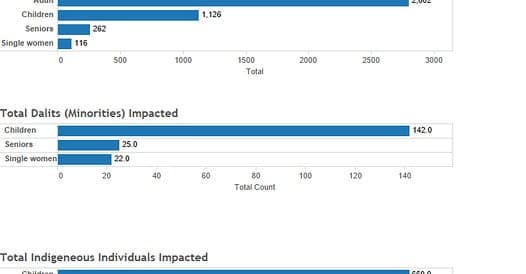
The organisation published a demographic breakdown of the people living in the houses it had built: children, seniors, single women and, counted separately, Dalit and indigenous households.
Mission Rebuild Nepal is a 501(c)(3) non-profit organization registered in the state of Virginia. Money leaves the United States in stages and each stage is released against receipts for the last one.