A dashboard breaks down who the houses actually reached
- Published
- Reading time
- 1 min
- Written by
- MRN
- Filed under
- Reconstruction
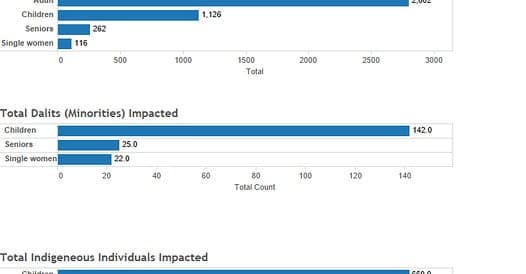
Counting houses is easy. Counting who is in them, and saying which of them belong to groups that relief operations routinely miss, is a different exercise.
In September 2016 the organisation published charts putting the total number of individuals served at more than four thousand, and broke that total down. Among them were 1,126 children, 262 seniors and 116 single women. Dalit households were counted separately, and included 142 children, 25 seniors and 22 single women. Indigenous households were counted separately again.
Single women are listed as a category because in rural Nepal a widowed or abandoned woman without a male household head is among the least likely people to be reached by an aid distribution, and among the least likely to be able to rebuild without help. The same logic applies to the Dalit count.
The organisation's own comment on the figures was brief and, for once, allowed itself a claim: that on the limited data available to it, it believed it had made the largest single contribution to post-earthquake rebuilding in Nepal. The evidence for that is the count, and the count is published.