Hospitals across Nepal; equipment manufactured in France
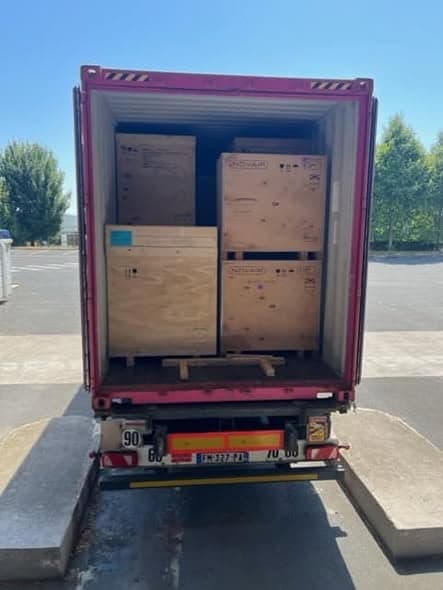
The plants loaded for sea freight at the Novair works, photographed by the manufacturer and published by Mission Rebuild Nepal on 21 July 2022.2022-07-21 · Novair S.A.
Summary
Nepal's second Covid-19 wave in the spring of 2021 exposed how little medical oxygen the country could produce for itself. Mission Rebuild Nepal led a consortium of eight organisations that bought ten oxygen generators and five high-pressure cylinder filling systems from Novair S.A. in France, then spent close to two years moving them through government approvals, a failed air-freight tender and a forced switch to sea cargo. The first installations were reported in January 2023.
Worked with
America Nepal Medical Foundation (ANMF)
Batas Foundation
Creasion
Humanity Foundation Nepal
Jagdamba Steel
Jyoti
Syakar Trading Company Pvt. Ltd.
Figures
What this project recorded
Each figure is drawn from the organisation's own records. The documents behind them are released on request.
10
Oxygen generators procured
Novair S.A. plants, each rated at 15 Nm³/h
5
High-pressure cylinder filling systems
250 LPM
Oxygen output per plant
15 Nm³/h at 95 ± 1 per cent purity
8
Organisations in the consortium
Seven partners alongside Mission Rebuild Nepal, which led procurement and supply chain
20 months
From launch to the first installations
Press conference 31 May 2021; installation report 27 January 2023
Buying the oxygen plants was the quick part. Getting them out of a factory in France, through a cabinet decision in Kathmandu, past a failed freight tender and into hospital plant rooms took the better part of two years. This is the record of how it went.
The second wave
Nepal was hit hard by the second wave of Covid-19 in early 2021. Infections and deaths rose at a rate that had been unimaginable in 2020, and demand for oxygen climbed with them. Hospitals and the government did not have enough oxygen plants or concentrators to meet it, and people died of oxygen deficiency that could have been prevented.
Working from estimates by medical professionals with experience of the system, the consortium settled on a package of oxygen generators together with high-pressure cylinder filling systems. Generators supply piped oxygen inside a hospital. Filling systems let that hospital charge cylinders, which is what reaches wards without pipelines and what travels to smaller facilities nearby. The two together do more than either alone.
A consortium, not a single donor
Mission Rebuild Nepal led the procurement and managed the supply chain, but the money and the standing came from eight organisations working under one banner. The consortium went public at a press conference in Kathmandu on 31 May 2021, attended by doctors, a representative of each member organisation, government officials and the press. MRN's president, Dr Madan Uprety, recorded an explanation of how the generators and filling systems work, and it was published the same day.
—America Nepal Medical Foundation (ANMF)
—Batas Foundation
—Creasion
—Humanity Foundation Nepal
—Jagdamba Steel
—Jyoti
—Mission Rebuild Nepal
—Syakar Trading Company Pvt. Ltd.
The equipment
The plants were built by Novair S.A. in France. Each generator produces 250 litres of oxygen a minute at a purity a hospital can rely on, and monitors itself well enough to stop rather than deliver gas below specification.
Manufacturer
Novair S.A., France.
Oxygen flow
15 Nm³/h, or 250 litres per minute.
Oxygen purity
95 ± 1 per cent.
Outlet pressure
4.5 to 6 bar.
Air filtration
Submicronic intake filtration at 0.01 μm, with a final outlet filter holding maximum solid particle size to the same 0.01 μm.
Monitoring
A digital display shows and records oxygen purity and pressure continuously, and logs alarms and events, preventive maintenance that has fallen due, and a countdown of oxygen produced.
Safety
An automatic shut-off valve closes if oxygen concentration drops below the required level.
Why the appeal continued after the plants were paid for
Shipping a plant from France to Nepal does not put oxygen into a patient. A generator only helps if it is carried to the hospital that needs it, kept running when the grid fails, and repaired when a compressor or a filter goes. Nepal's public hospitals are spread across a country where the last stretch of road is often the hardest, and a machine that stops for want of a spare part is a machine that is not saving anyone. The fundraising after the purchase covered exactly three things.
—Local transportation, moving the plants from the port to hospitals in different parts of the country.
—Backup generators, so a plant keeps producing through a power cut.
—Maintenance, support and a stock of spares, so a fault is a delay rather than the end of the plant's working life.
Two years of decisions, tenders and freight
The delay was not in the factory. It was in the arrangements around it: which ministry would pay for the cargo, which airline would tender for it, and whether the plants would fly or float. The chronology below is the one Mission Rebuild Nepal kept and published while the project was live.
2021-05-31
The Oxygen for Nepal consortium goes public at a press conference in Kathmandu, with doctors, member organisations, government officials and the press present.
2021-06-16
The Covid-19 Crisis Management Centre formally decides to help with the air cargo of the oxygen plants.
2021-07-13
The government changes. Sher Bahadur Deuba becomes Prime Minister.
2021-07-24
Mission Rebuild Nepal publishes a notice acknowledging the delay in the air-cargo arrangement and apologising to donors and partner organisations.
2021-08-11
The Ministry of Finance agrees to fund the air cargo, and asks that the budget of the Ministry of Health and Population be used.
2021-08-16
The Ministry of Health and Population formally agrees to request the funds from cabinet.
2021-08-19
Cabinet approves the funds and directs Nepal Airlines Corporation to begin procurement.
2021-09-20
Nepal Airlines publishes its tender. Flash Freight's first bid of $357,000 exceeds the $275,000 the government had allocated, and the tender fails.
2021-11-20
The tender is reissued with relaxed clauses. Flash Freight is the sole bidder and wins.
2021-12-31
Flash Freight and the consortium set 12 January 2022 as a hard deadline, conditional on the health ministry releasing payment to Nepal Airlines by the end of December.
2022-01-07
The payment to Nepal Airlines has still not completed. Flash Freight, which had already asked Novair to prepare the cargo for pickup, cancels the 12 January air charter.
2022-01-31
After a month of lobbying by Mission Rebuild Nepal, the health ministry agrees to release the payment.
2022-02-07
The funds are deposited into Nepal Airlines' account in early February.
2022-02-24
Citing the conflict in Ukraine, Flash Freight says on 24 and 28 February that it can no longer airlift the plants at the price it quoted.
2022-03-05
Mission Rebuild Nepal writes to Nepal Airlines and Flash Freight arguing that force majeure does not apply, because the war had not affected air movement in France or elsewhere in Europe, and seeks a remedy for the damage to the project. Flash Freight agrees to ship everything by sea at its own cost.
2022-03-06
Flash Freight asks Nepal Airlines for a supporting letter from the health ministry to obtain EU approval for an airlift, offering a 10 March departure. Nepal Airlines forwards the request the same day.
2022-03-11
Novair notifies Medioxy that repackaging will cost a further EUR 32,000. The plants had already been packed for air freight, and that packing could not be used at sea without an oxidation risk that would have voided the warranty.
2022-03-15
All consortium members agree to pay the repackaging cost and authorise Mission Rebuild Nepal to proceed with sea cargo.
2022-03-24
The health ministry replies to Nepal Airlines, advising against air movement, directing the alternative sea route, and asking that the unspent balance be returned.
2022-04-27
Nepal Airlines confirms the sea route on 18 April. Flash Freight then tells Nepal Airlines it will carry the cargo free of charge under its corporate social responsibility programme.
2022-05-04
The repackaging payment to Novair clears, after technical problems in the SWIFT system held it up. In the third week of May, Novair confirms repackaging will be finished by the end of June.
2022-07-21
Flash Freight collects all ten plants and five filling systems from the factory for sea freight. Mission Rebuild Nepal reports an estimated 70 to 75 days to Birgunj.
2023-01-27
Three of three generators funded by the America Nepal Medical Foundation are reported installed, along with a plant donated by Creasion at Teaching Hospital. Six remain to be installed.
Loading at the Novair works, July 2022.2022-07-21 · Novair S.A.
Where the plants went
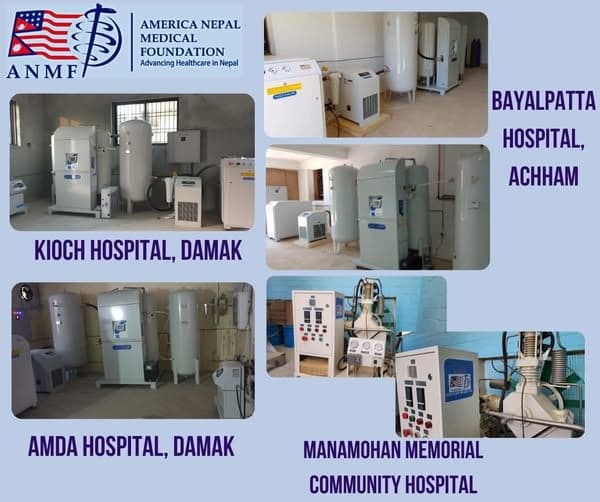
On 27 January 2023 Mission Rebuild Nepal shared the America Nepal Medical Foundation's installation report and closed the project. The report pictured working plant rooms at Kioch Hospital and AMDA Hospital in Damak, at Bayalpatta Hospital in Achham, and a cylinder filling system at Manamohan Memorial Community Hospital. A further plant, donated by Creasion, had been installed at Teaching Hospital. Six of the ten were still awaiting installation at that date.
Installations reported by the America Nepal Medical Foundation, January 2023: Kioch Hospital and AMDA Hospital in Damak, Bayalpatta Hospital in Achham, and a cylinder filling system at Manamohan Memorial Community Hospital.2023-01-27 · America Nepal Medical Foundation
“It took a little longer than expected, still we are happy in completing this project and serving Nepalese communities.”
Cross-checked
The same project in the impact index
These are the figures the organisation holds for this project across its whole record, each with the source it rests on. Where the archive disagreed with itself, the discrepancy is stated rather than resolved quietly.
10
Oxygen plants procured and shipped
Supplied with high-pressure cylinder filling systems for government hospitals across Nepal.
250 LPM
Oxygen output per plant
Novair generators, 15 Nm3/h, purity 95 plus or minus 1 per cent, with submicronic air filtration and continuous purity monitoring.
4
Plants installed by January 2023
Three funded by the America Nepal Medical Foundation, and one donated by Creasion and installed at Teaching Hospital. Six remained to be installed.
$0
Cost of the final shipment
After the air-cargo route collapsed twice, Flash Freight moved the entire consignment by sea free of charge under its corporate responsibility programme.
Field updates
Written while it was happening
The organisation posted as the work went on. These are the most recent updates filed against this project.
Twenty months after the Oxygen for Nepal consortium was formed, three generators funded by the America Nepal Medical Foundation were reported installed and working, along with one donated by Creasion. Six of the shipped plants were still waiting.
The plants were meant to be airlifted in weeks. Instead they sat in a French factory for more than a year while a government tender failed, a war was invoked, and the crates had to be repacked to survive a sea voyage.
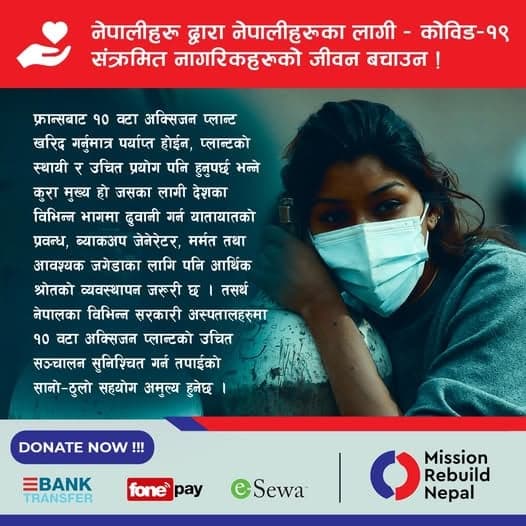
With the generators bought, Mission Rebuild Nepal began asking for a different kind of money: transport to hospitals across the country, backup generators, spare parts and maintenance. The appeal reached more than six thousand people.
Mission Rebuild Nepal is a 501(c)(3) non-profit organization registered in the state of Virginia. Money leaves the United States in stages and each stage is released against receipts for the last one.